Emma Obrietan: "Artist's Relief"
Wednesday 4th February, 14:30
5b presents Artist’s Relief, an exhibition by Hamburg-based artist Emma Obrietan.
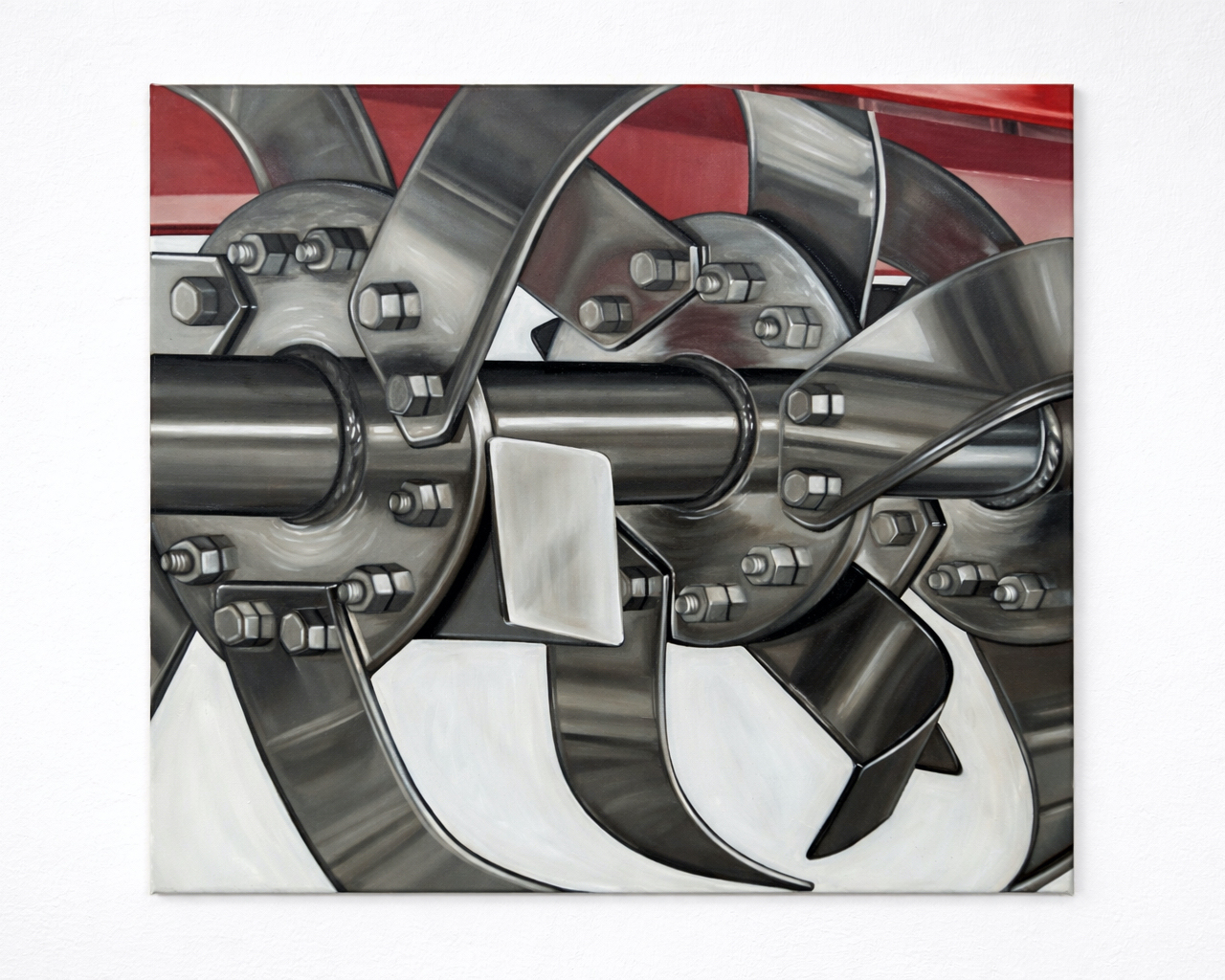
In terms of the content or subject matter of the works in this exhibition, we might again cite Photorealism’s concern with ordinary things (signage, machines, commodities) and everyday scenes. Obrietan’s interest in the quotidian, however, is better framed as a layered engagement with a different realist tendency in twentieth-century American art: the traditional, value-laden images of technological and industrial progress celebrated in the regionalist impulse of American painting of the 1920s and 1930s, particularly the realism of New Deal-era WPA Federal Art Project painting. As with her methodological disruption of Photorealism, Obrietan’s approach again hinges on deliberately skewing or polluting her historical reference point. The close-cropping of Cultivator (2025), for example, produces an uncanny ‘all-over’ image, zoomed-in framing creating an awkward proximity that interferes with the clarity or transparency of the depicted machine. The result is the transformation of an ostensibly realist image into one that is abstract and disorientating to look at. ‘All-over’ painting – long associated with Abstract Expressionism following Pollock’s late 1940s and early 1950s canvases, works that eschewed centrality and balanced relationality in favour of a flattened, wallpaper-like approach covering the entirety of the canvas – historically succeeded New Deal-era Federal Art Project realism. Cultivator therefore collapses two proximal yet oppositional moments in mid-century American painting, amounting to yet another disruptive historical procedure taking place in Obrietan’s painting.
—excerpted from the exhibition text by Paul Pieroni
Image: Emma Obrietan, Cultivator, 2025. Courtesy of the artist and 5b, Glasgow.
Location and accessibility: The studio is situated in a B-listed building in Glasgow's city centre, located in close proximity to both Glasgow Central and Queen Street train stations, St Enoch subway station and numerous stops served by public bus operators. There is on-street ticketed parking available. There are three steps to enter the building, and a further six steps to access the studio. Regretfully, due to the building's listed status, the studio is inaccessible for wheelchairs. Please let us know about any special requirements in advance and we will try to make your visit as comfortable as possible.
Bookings are currently unavailable